Blogging and Monetization
This time, I’d like to write about something I’ve never discussed before during my years of blogging: monetization for web media.
Monetization is a topic that easily attracts attention, but I had avoided discussing it because it felt like revealing the backstage workings of the blog, and I didn’t think it was something a tech blog should focus on. However, as malicious web advertising has become a social issue and people increasingly rely on AI chat tools instead of blogs and web media for information, maintaining a web presence has become much more difficult. For that reason, I wanted to share some thoughts about monetization, which is difficult to avoid when operating a media site under your own domain.
Please note that this article discusses Japanese commerce and legal systems in several places. Circumstances may differ outside Japan.
The Pros and Cons of Advertising That Supported the Web
As many of you know, this blog displays advertisements through Google AdSense. The revenue from those ads has covered server and domain costs, allowing me to keep the blog running without operating at a loss. For that, I am genuinely grateful.
A small blog like mine does not generate significant revenue, but there is no doubt that web advertising played a major role in the growth of the IT industry. Many services and web media sites were built on advertising revenue.
At the same time, we have seen:
- An increase in low-quality and malicious web advertisements, turning them into a social problem
- A flood of low-quality articles created solely for advertising revenue
- Reduced search traffic and declining ad revenue due to the rise of AI chat tools
- More websites filling pages with ads to compensate for declining income
Because of these changes, I believe the relationship between advertising and media is also changing.
Advertisements that once supported web media have increasingly become a nuisance that interferes with content. Media operators say, “Become a paid member and we’ll remove the ads,” while users respond by installing ad blockers.
Exploring Ways to Sustain an Independent Blog
When I redesigned this blog, I significantly reduced the number of advertisements in order to provide a more pleasant reading experience.
As revenue declined, the options available to me for maintaining the blog were:
- Increase the number of advertisements
- Abandon my independent domain and move to platforms such as note or Zenn
- Sell paid articles
- Allow readers to support the blog through donations
Increasing the number of ads would have made the site more annoying for readers, which was something I wanted to avoid as someone trying to share information.
Abandoning my independent domain was also out of the question. It would mean giving up a blog that I had not only nurtured for years but even built a custom blogging system for.
Another reason I write is to give back to the free software and open-source projects that have helped me throughout my career. Because I want information to remain accessible to everyone, selling paid articles is not something I am currently considering.
That led me to wonder: what if people who enjoy and support this blog could simply buy me a cup of coffee?
That idea drew my attention to creator-support platforms. Adopting Ko-fi is one step in that ongoing experiment. It is the answer I arrived at for helping a small independently operated blog survive without depending entirely on large platforms.
What Is Ko-fi?
Ko-fi is a platform designed to support creators. Its concept is simple: supporting creators should be as easy as buying them a cup of coffee.
A very similar service is Buy Me a Coffee (BMC). Both are well-known platforms and are particularly popular among tech creators.
Although the two services are quite similar, their main differences are payment systems and fees. As of June 2026, the comparison looks roughly like this:
| Item | Ko-fi | Buy Me a Coffee |
|---|---|---|
| Payment Systems | PayPal, Stripe | Stripe only |
| Platform Fee | 0-5% for one-time donations. Shop, membership and commissions features incur a 5% fee. | 5% of the payment amount |
| Login Required for Payment | No | No |
To put it bluntly, both Ko-fi and BMC primarily provide an attractive front-end that connects supporters with payment processors. The actual payment handling is performed by the connected payment system.
BMC previously supported PayPal but now relies exclusively on Stripe. As a result, if you’re already using Stripe with Ko-fi, migrating to BMC later would be relatively straightforward.
In Japan, thanks in part to platforms such as YouTube and note, “tipping” has become widely accepted and is increasingly recognized as a source of income for creators.
There are many creator-support services available both in Japan and abroad, but some examples that support one-time donations for bloggers include:
- Codoc: A service primarily focused on paid blog content and donations
- OFUSE: A service that allows supporters to send fan letters that are converted into monetary support
- Ko-fi: A platform that makes it easy to support creators with the equivalent of a cup of coffee, supporting both PayPal and Stripe
- Buy Me a Coffee: A service with a similar concept and interface to Ko-fi, charging a flat 5% fee
In addition to these services, GitHub Sponsors also relies on Stripe for payment processing (Ko-fi is the only one among these that also supports PayPal).
In other words, a Stripe account is a critical part of many creator-support services. If your Stripe account were suspended, you could lose access to a large number of these platforms.
Steps to Set Up Ko-fi
Below is a brief overview of how to set up Ko-fi.
- Create a Ko-fi account
- Decide whether to use PayPal, Stripe, or both
- Connect your payment processor account, creating one if necessary
- Customize your payment page and profile
- Add a link to Ko-fi on your blog or website
Creating a Ko-fi account and choosing a payment processor are straightforward. In fact, creating a Ko-fi account takes only a few minutes if you have an email address.
The more challenging part is setting up the payment processor account. In particular, I found many reports online from people who struggled with Stripe’s review process. I’ll discuss that in the next section.
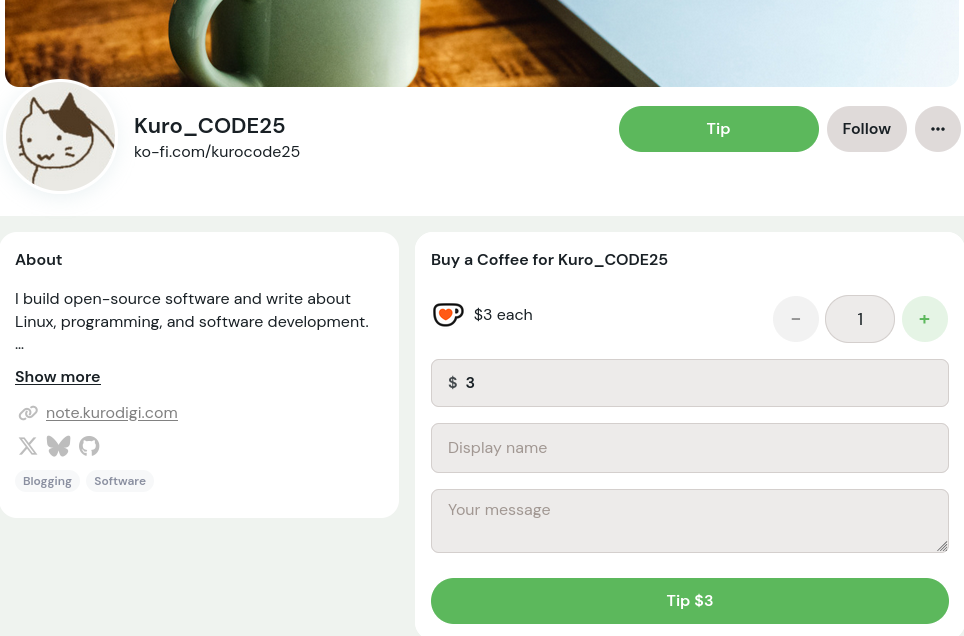
My Ko-fi home page
Things to Watch Out for When Creating Accounts
Prepare a PayPal Business Account
PayPal Personal accounts are intended for transfers between family members and acquaintances.
Using one to collect support from an unspecified number of people may violate PayPal’s terms and could result in account suspension.
If you plan to connect PayPal to Ko-fi, make sure to use a Business account.
Displaying Information Required by Japan’s Specified Commercial Transactions Act Matters for Stripe Reviews
While researching Ko-fi and BMC, I found many reports from people who had difficulty getting approved by Stripe.
Based on what I observed online, it seemed significantly harder to pass Stripe’s review process when the business model was unclear or when the website lacked information required under Japan’s Specified Commercial Transactions Act (hereafter referred to as SCTA disclosures).
I passed the review on my first attempt, partly because I carefully prepared in advance based on those reports.
Since Stripe does not publicly disclose all review criteria, each case may require different responses. However, the following preparations proved worthwhile:
- Preparing a website that clearly showcases my work, including software projects and blog articles
- Creating an SCTA disclosure page and making it accessible through links on the submitted website
- Clearly explaining my business model, including my open-source development activities, technical blogging, and the purpose of receiving support through Ko-fi
I believe it is important to clearly communicate that you are engaged in these activities, that people wish to support them, and that you want to use Stripe as the payment processor for receiving that support.
Phone Numbers and Addresses May Be Omitted from SCTA Disclosures
Many individuals and sole proprietors feel uncomfortable about publicly displaying their phone numbers in SCTA disclosures.
However, these personal details do not always have to be displayed publicly. Under certain conditions, they may be omitted by including wording such as “Will be disclosed without delay upon request.”
In my case, I applied to Stripe as an individual, and my review was approved even though my address and phone number were not publicly displayed.
There are also interpretations suggesting that SCTA disclosures may not be required if there is no ongoing commercial activity or if only donations are being accepted. However, Stripe may still require such disclosures during its review process.
For that reason, I would personally recommend keeping the disclosure page available even after approval in order to avoid future account issues.
I am not a legal professional, so I cannot guarantee the accuracy of those legal interpretations.
Final Thoughts
As I mentioned at the beginning, I have rarely discussed the behind-the-scenes aspects of running this blog. Since this blog is not intended to teach monetization strategies, I was somewhat hesitant to write an article like this.
However, after operating a small independent blog for more than ten years, I wanted to share my thoughts on the sadness of seeing advertising—something that once supported web media—gradually undermined by low-quality and malicious ads, as well as the importance of exploring alternatives that do not rely entirely on advertising revenue.
Today, many people write technical articles on platforms such as Qiita, note, and Zenn, and many readers spend more time on social media than on blogs.
But to everyone still running an independent blog under their own domain: let’s keep going.
I hope this article was helpful.
If you found my articles, open-source projects, or technical work useful, I would greatly appreciate your support through the equivalent of a cup of coffee.
Thank you for reading.
References
-
Specified Commercial Transactions Act Guide (Consumer Affairs Agency of Japan) https://www.no-trouble.caa.go.jp/consultation/
-
What Is a Specified Commercial Transactions Act Disclosure? A Simple Guide with Templates (Stripe) https://stripe.com/jp/resources/more/specified-commercial-transactions-act-japan
-
About Disclosures Required Under the Specified Commercial Transactions Act (note) https://www.help-note.com/hc/ja/articles/360008947533-特商法の表示について
-
PayPal User Agreement https://www.paypal.com/jp/legalhub/paypal/useragreement-full?locale.x=ja_JP
-
Why I Gave Up on Buy Me a Coffee + Stripe and Switched to Ko-fi + PayPal https://note.com/room_triple_kin/n/n6d76352c5499
-
I Introduced Buy Me a Coffee, but My Payment Account Was Suspended https://kotonakarebel.com/entry/260510BMC
